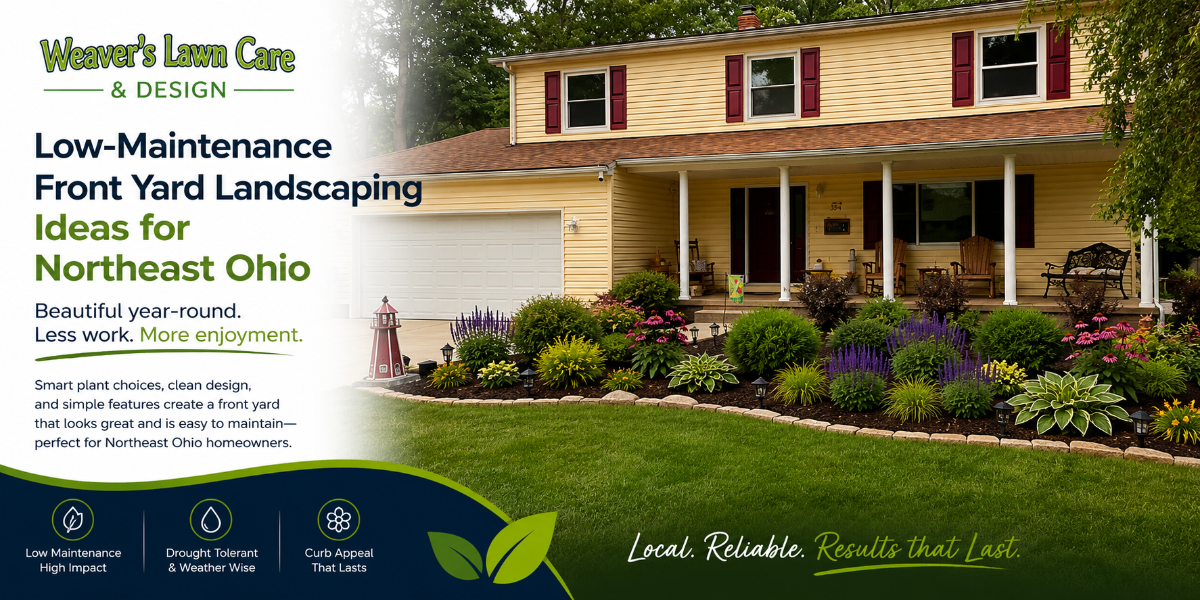
Low-Maintenance Front Yard Ideas for Northeast Ohio
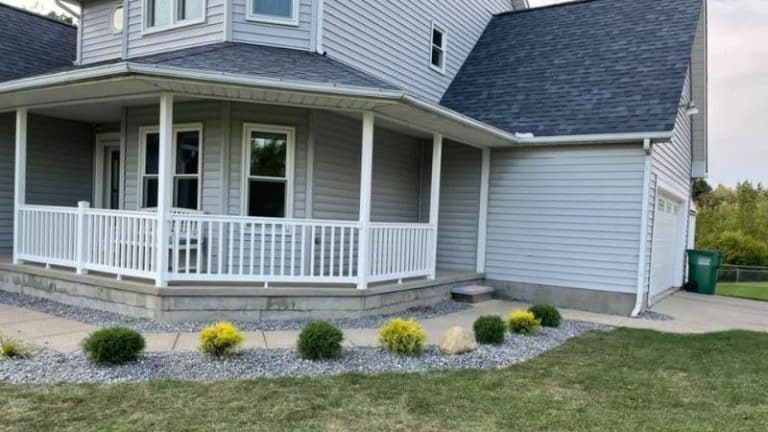
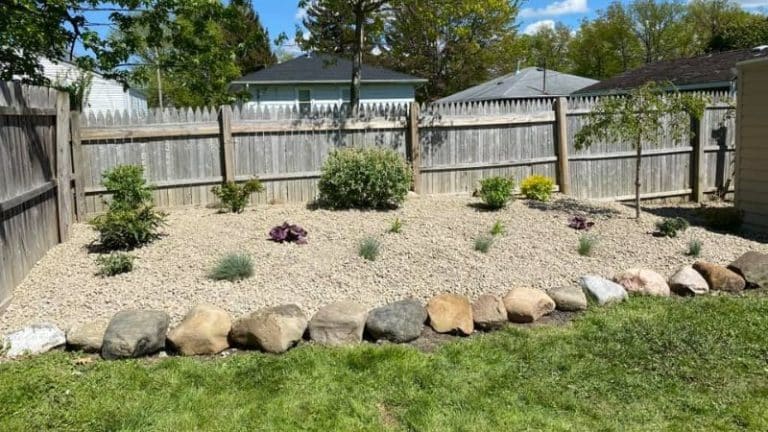
Low-maintenance front yard landscaping is not about removing every flower, covering the beds in rock, or planting a row of identical evergreens. A front yard can have plenty of color and character without requiring constant pruning, weeding, watering, and weekend cleanup.
For many Northeast Ohio homeowners, the real problem is that the existing landscape was never designed with maintenance in mind. Shrubs were planted too close to windows, garden beds contain too many different plants, fast-growing varieties need to be trimmed several times a year, and plants that looked small when they were installed have gradually taken over the front of the house.
At Weaver's Lawn Care & Design, we design and renovate residential landscapes throughout Lake County and surrounding Northeast Ohio communities. A big part of creating an easier yard is looking beyond what will look good immediately and thinking about how the landscape will grow over the next five, ten, and fifteen years.
For homeowners in Perry, Madison, Mentor, Painesville, Concord, Kirtland, Chardon, Geneva, and nearby communities, these are some of the most practical ways to create a front yard that looks finished without becoming another maintenance project.
Start by simplifying an overgrown front landscape
If your front yard already feels like too much work, adding more plants is rarely the answer. It usually makes more sense to begin by figuring out what is creating the maintenance problem.
Older foundation beds often contain plants added at different times by different homeowners. There may be several shrubs that have outgrown their spaces, perennials spreading into one another, and plants tucked into every opening that happened to be available.
A professional garden bed renovation can simplify those areas rather than automatically replacing everything.
Start by looking for:
-
- Shrubs that constantly need to be cut away from windows
- Plants growing across walkways or steps
- Perennials that have spread well beyond their intended areas
- Plants that are unhealthy or no longer add much to the landscape
Removing the plants that create the most work can immediately make the front yard easier to manage. Healthy, appropriately sized plants can often stay and become part of the new design.
Choose shrubs based on mature size instead of nursery size
One of the biggest causes of high-maintenance landscaping is putting a plant into a space it will eventually outgrow.
A young shrub in a nursery container looks small against a house. Homeowners understandably want the new landscape to look full, so several shrubs may be installed close together or too close to the foundation. Within a few years, the plants are touching one another and growing over windows.
When planning a landscape design, mature dimensions should determine where a plant goes.
Before choosing a shrub, consider:
-
- How tall it will naturally become
- How wide it will grow without pruning
- Where nearby windows and walkways are located
- How much space it needs between the house and neighboring plants
A shrub that naturally stays below a window is much easier to live with than one that wants to grow six feet tall and has to be repeatedly cut back to three feet.
Use fewer plant varieties and repeat them throughout the yard
A low-maintenance front yard does not need a different plant in every available space. In fact, using too many varieties can make both the appearance and upkeep more complicated.
A simpler plant palette often looks more intentional. Instead of choosing fifteen unrelated plants, a design might use a few dependable shrubs, two or three perennial varieties, and an ornamental grass repeated through the beds.
A straightforward planting plan might include:
-
- One main flowering shrub used in several areas
- Compact evergreens for year-round structure
- Groups of the same perennial for seasonal color
- One ornamental grass repeated for texture
This is an approach Weaver's can use when planning a new landscape installation. Repetition makes the front yard feel connected and leaves homeowners with fewer different plants to understand and maintain.
Use flowering shrubs to get more color with less work
You do not need to fill the front yard with annual flowers to have color. Flowering shrubs can provide a much larger display and return every year.
Panicle hydrangeas are especially useful in Northeast Ohio because there are varieties available for both larger and smaller spaces. Spirea can also work well in sunny locations where a more compact flowering shrub is needed.
Flowering shrubs can be used:
-
- In groups through larger foundation beds
- Near the front entrance for seasonal color
- Behind lower perennials and grasses
- To replace older shrubs that offer little visual interest
The important part is still choosing the right size. During a front garden bed renovation, compact varieties can be used underneath windows while larger flowering shrubs are reserved for areas where they have room to develop.
Keep enough evergreens to make the yard look good in winter
Northeast Ohio landscapes spend several months without the flowers and foliage we enjoy during summer. If every plant in the front yard disappears or loses its leaves, the beds can look empty from late fall through early spring.
Evergreens help provide structure during that period, but you do not need to return to the traditional wall of foundation shrubs.
A few well-positioned evergreens can:
-
- Frame the front entrance
- Anchor the corners of larger planting beds
- Provide contrast behind flowering perennials
- Keep some greenery around the house throughout winter
Appropriately sized evergreens should need only occasional attention rather than constant shaping. When existing shrubs are worth keeping, Weaver's also provides hedge and bush trimming to keep established landscaping looking neat.
Add perennials in groups instead of scattering them everywhere
Perennials are an easy way to bring more color into a low-maintenance front yard, but the way they are used matters.
Planting one of everything can create a garden that looks busy and requires you to remember the needs of dozens of individual plants. Larger groups of the same perennial are generally easier to maintain and create more visual impact when they flower.
Depending on sunlight and growing conditions, a professional planting design might incorporate plants such as:
-
- Catmint for long-lasting color in sunny areas
- Black-eyed Susans for summer flowers
- Purple coneflower in sunny, pollinator-friendly beds
- Hostas for appropriate shaded areas
Perennials still need some seasonal cleanup, but most do not require the repeated trimming associated with an oversized foundation hedge. They also return each year instead of needing to be replanted every spring.
Use ornamental grasses to add interest without another row of shrubs
If a landscape is made almost entirely from shrubs, homeowners often keep adding more shrubs whenever an opening appears. Ornamental grasses offer another option.
Grasses provide movement and texture, and many look particularly good in late summer and fall when other plants are beginning to finish for the season. Depending on the variety, they can range from relatively compact plants to larger accents.
Ornamental grasses work well:
-
- Between groups of flowering shrubs
- At transitions between different garden beds
- Behind lower perennial plantings
- Where the landscape needs additional fall interest
Many grasses primarily require one seasonal cutback rather than repeated maintenance throughout the summer. Weaver's also offers seasonal yard cleanup for homeowners who would rather have spring and fall cleanup handled professionally.
Consider native plants where they fit the property
Native plants can work very well in lower-maintenance Northeast Ohio landscapes, particularly when homeowners want a more natural appearance or want to support pollinators.
The important part is not assuming that every native plant is automatically easy. A native shrub that grows eight feet wide can still be a maintenance problem when planted in a four-foot foundation bed.
Depending on the property, native options might include:
-
- Ninebark in areas with room for a larger shrub
- Serviceberry as a small ornamental tree
- Black-eyed Susans and coneflowers for sunny perennial beds
- Little bluestem for native texture and fall interest
Weaver's can incorporate native plants into a broader residential landscape renovation without making the entire front yard look like a meadow. Native and ornamental plants can work together when each is chosen for the right location.
Make the garden beds large enough for the plants
Sometimes the easiest way to reduce maintenance is to change the garden bed rather than searching for increasingly smaller plants.
Many older Northeast Ohio homes have narrow strips of landscaping squeezed between the lawn and foundation. There simply is not enough room to create layers or allow medium-sized shrubs to develop naturally.
Expanding a bed can provide:
-
- More distance between shrubs and the house
- Space for smaller plants in front of larger shrubs
- Better separation between plants as they mature
- Cleaner proportions between the landscaping and the house
A professional garden bed renovation can reshape older beds and create a layout that works better with the plants you actually want to use. This can make a bigger difference than simply replacing old shrubs in the same locations.
Keep garden bed shapes simple
Complicated garden bed shapes may look interesting on paper, but every tight curve and narrow strip creates another area that has to be edged and mowed around.
For a lower-maintenance front yard, simpler bed lines usually make more sense. The beds can still have gentle curves and follow the architecture of the house without becoming unnecessarily complicated.
Good bed design should:
-
- Be easy to mow around
- Provide enough room for mature plants
- Connect related planting areas naturally
- Avoid narrow sections that are difficult to maintain
Once the layout is established, professional mulch installation can create a clean transition between the lawn and the renovated beds while covering the open soil between plants.
Use mulch instead of trying to fill every opening with a plant
A new landscape does not need to look completely full on the day it is installed. In fact, trying to achieve that look usually means too many plants have been used.
Young shrubs and perennials need space to reach their mature sizes. Mulch can cover those intentional openings while the landscape develops.
A properly mulched bed can help:
-
- Reduce exposed soil where weeds can establish
- Retain soil moisture during dry periods
- Create a consistent finished appearance
- Make properly spaced young plants look intentional
Weaver's provides professional mulch installation for both new and established landscapes. Mulch still needs to be refreshed periodically, but it is generally much easier to manage than an overcrowded bed filled with unnecessary plants.
Use one ornamental tree instead of filling a large area with shrubs
Some front yards need height, particularly around larger or two-story homes. That does not mean the answer is planting more shrubs.
A properly located ornamental tree can provide height and structure while becoming a focal point for the surrounding landscape. Serviceberry and other appropriately selected small trees can also provide flowers, fall color, or other seasonal interest.
An ornamental tree may work well:
-
- Near a corner of the house with adequate space
- Within a larger front garden bed
- As a focal point away from the foundation
- Where the landscape needs vertical interest
A landscape design should consider mature canopy size, windows, utilities, walkways, and the view of the house before deciding where a tree belongs. A well-positioned tree can do more visually than a large collection of smaller plants.
Add landscape lighting instead of adding more landscaping
If the front yard feels like it needs something more, additional plants are not always the answer. Landscape lighting can change the appearance of an existing planting without adding anything else that needs pruning or seasonal cleanup.
A few carefully positioned fixtures can highlight the strongest parts of the landscape and make the entrance more inviting after dark.
Professional landscape lighting can be used to:
-
- Highlight an ornamental tree or attractive shrub
- Add visibility along the front walkway
- Draw attention toward the front entrance
- Create depth across larger planting beds
If the front landscaping is already being renovated, it is a good time to consider lighting so the fixtures can be planned around the new plants rather than added as an afterthought.
Do not replace lawn with planting beds unless it actually reduces your workload
Removing lawn is sometimes promoted as an automatic way to reduce yard maintenance, but that is not always true in Northeast Ohio.
A healthy section of lawn can be relatively straightforward to maintain. Replacing it with a large garden full of dozens of perennials may actually create more weeding, dividing, cutting back, and seasonal cleanup.
Before expanding a bed into the lawn, consider:
-
- How much additional planting will be required
- Whether the new area will need regular weeding
- How much seasonal cleanup the plants require
- Whether the larger bed actually improves the overall design
Weaver's provides both landscaping services and lawn care, so the goal can be finding a sensible balance between lawn and garden beds rather than assuming one is always easier than the other.
Plan for the maintenance you are actually willing to do
There is a big difference between someone who enjoys spending a Saturday morning working in the garden and someone who wants the front yard to look good with minimal personal involvement.
That should influence the design from the beginning.
If low maintenance is a priority, tell your landscaper you would prefer:
-
- Plants that require limited pruning
- Fewer perennial varieties to manage
- Simple garden bed shapes
- Enough spacing for plants to grow naturally
For homeowners who want an attractive landscape without handling all of the upkeep themselves, Weaver's also provides landscape maintenance services. Designing for easier maintenance still matters because it reduces unnecessary work whether you are doing it yourself or hiring someone else.
Choose a Northeast Ohio landscaper who plans beyond installation day
A front yard can look fantastic when everything is freshly planted and still become a maintenance problem several years later. The real test of a landscape design is how well it ages.
Weaver's Lawn Care & Design is a locally owned, husband-and-wife operated company providing residential landscaping and landscape renovation throughout Lake County and surrounding Northeast Ohio communities. Bob Weaver manages operations, crews, and client relationships, while co-owner Jessica leads the landscape design side of the business.
When we evaluate an older front yard, we can look at what is already working before deciding what needs to change. A mature tree may be worth keeping. Several shrubs may only need pruning. Other plants may have outgrown their locations and be better replaced with something appropriately sized.
The new landscape can then be designed around how much maintenance you actually want, rather than simply filling every available space with new plants.
Proudly serving homeowners throughout Lake County and Northeast Ohio
Weaver's Lawn Care & Design provides landscape design, garden bed renovation, planting, landscape lighting, mulch, lawn care, and property maintenance throughout our Northeast Ohio service area, including:
-
- Madison
- Perry
- Geneva
- Mentor
- Painesville
- Concord
- Chardon
- Kirtland
- Eastlake
- Wickliffe
- Willowick
A low-maintenance landscape in Northeast Ohio still has to deal with spring growth, summer heat, fall leaves, freezing winters, and the changing conditions created by mature trees. The easiest yards to maintain are generally the ones where the plants and layout were chosen with those realities in mind.
Weaver's can combine a front yard renovation with mulch installation, shrub trimming, seasonal cleanup, landscape lighting, lawn care, and ongoing maintenance to make the entire property easier to manage.
Ready for a front yard that requires less work?
If your current landscaping has become a constant cycle of trimming, weeding, cutting plants away from windows, and trying to keep everything under control, replacing it with younger versions of the same plants will not solve the problem.
A better low-maintenance front yard starts by deciding what is worth keeping, removing plants that have outgrown their locations, simplifying the planting palette, and giving the new plants enough room to mature naturally. Properly shaped garden beds, mulch, strategic evergreens, flowering shrubs, perennials, and ornamental grasses can still create plenty of curb appeal without packing every available space with something that needs attention.
You also do not necessarily need to start over. A professional evaluation can identify the parts of your existing landscape that already work and focus your budget on the areas that are actually creating problems.
Contact Weaver's Lawn Care & Design to request a landscape evaluation and estimate for a low-maintenance front yard, garden bed renovation, or new landscape design in Perry, Madison, Mentor, Painesville, Concord, Kirtland, Chardon, Geneva, or the surrounding Northeast Ohio area.