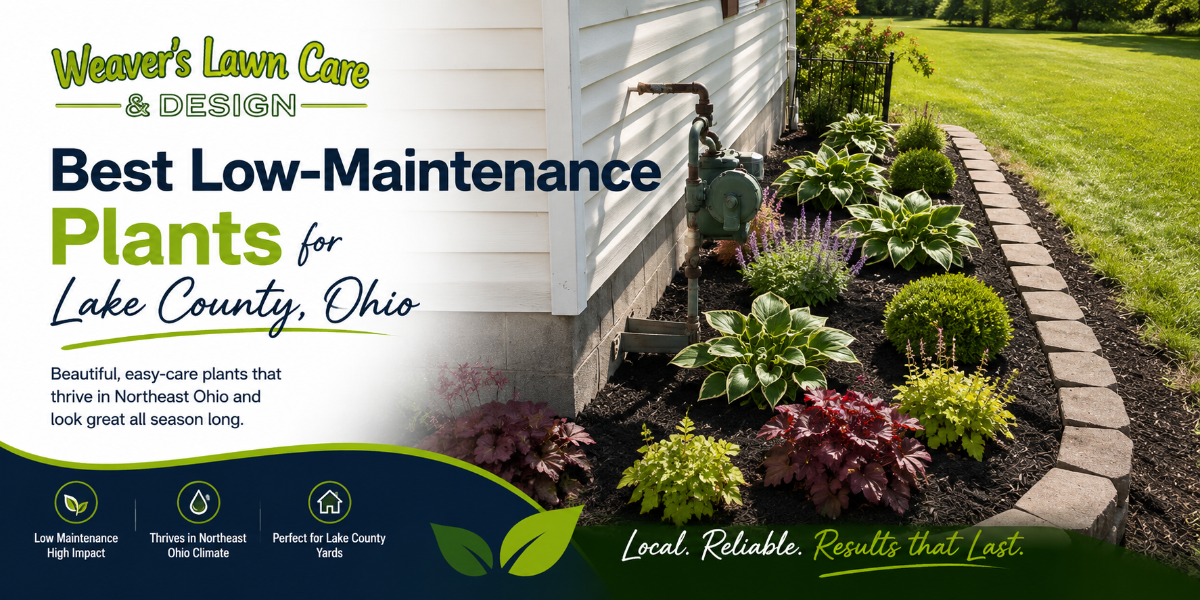
Best Low-Maintenance Plants for Lake County
If you want attractive landscaping without spending every weekend pruning shrubs, pulling weeds, and replacing plants that did not make it through the winter, plant selection matters. Some plants simply make more sense for Northeast Ohio than others, and choosing the right ones can make a noticeable difference in how much work your landscaping requires over time.
At Weaver's Lawn Care & Design, we design and install landscapes throughout Lake County and the surrounding Northeast Ohio area. A lot of the properties we work on already have established landscaping, but it may be overgrown, dated, or difficult for the homeowner to keep up with. In many cases, the problem is not that the yard needs more plants. It needs better plants in better locations.
A low-maintenance landscape still needs some care. Shrubs need occasional pruning, perennials need seasonal cleanup, beds need mulch, and weeds will always find opportunities to appear. The goal is to create landscaping that does not constantly fight against the property or require excessive work just to keep it looking presentable.
For homeowners in Perry, Madison, Mentor, Painesville, Concord, Kirtland, Chardon, Geneva, and nearby communities, the following plants and design ideas are a good place to start.
Start with plants that are suited to your property
Before choosing specific plants, take a good look at where they are actually going. One of the most common reasons landscaping becomes difficult to maintain is that plants were chosen for their appearance without enough consideration for the conditions around the house.
The front of a home might receive full afternoon sun while a side bed stays shaded for most of the day. One part of the property may drain quickly while another stays wet after heavy rain. These differences matter, even when the planting areas are only 30 or 40 feet apart.
When we plan a landscape design, some of the first things we consider are:
-
- The amount of sun each planting area receives
- How well the soil drains after rain
- The mature height and width of the plants
- How much ongoing pruning and cleanup the homeowner wants to do
A plant that naturally likes the conditions where it is planted usually needs less help to stay healthy. That is the foundation of a lower-maintenance landscape.
Panicle hydrangeas are hard to beat for summer color
Hydrangeas are extremely popular in Northeast Ohio, and panicle hydrangeas are especially useful in residential landscapes. They handle our winters well, produce large flowers through the summer, and can provide plenty of impact without needing a complicated maintenance routine.
There are also many sizes available now. Some varieties stay relatively compact, while others can become large shrubs. That gives us quite a bit of flexibility when using them around a house.
Hydrangeas work well for:
-
- Adding color to foundation beds
- Creating larger flowering groups along the house
- Adding height behind smaller perennials
- Drawing attention to entrances and other focal areas
The mistake we often see is a large hydrangea planted underneath a window or squeezed into a bed that is much too small for it. The plant itself is not particularly difficult to maintain, but it becomes difficult when it has to be constantly cut back to keep it from taking over.
During a garden bed renovation, we look at how large existing plants have become and make sure replacements have enough room to mature naturally.
Spirea is a dependable flowering shrub for sunny areas
Spirea has been used in Northeast Ohio landscapes for a long time, and there is a reason it continues to be popular. It is hardy, dependable, available in several sizes and foliage colors, and generally does not require a lot of attention once established.
It is particularly useful in sunny planting beds where you want something with more color than a traditional evergreen shrub.
Spirea can provide:
-
- Spring or summer flowers depending on the variety
- Compact structure in smaller garden beds
- Yellow, green, or darker foliage depending on the cultivar
- A good transition between larger shrubs and smaller perennials
Rather than planting one spirea here and another somewhere else, we often prefer repeating plants in groups. Repetition makes a landscape look more intentional and avoids the cluttered appearance that can happen when every plant in a bed is different.
That approach works particularly well when planning a larger landscape installation or renovation.
Catmint works well along sunny garden beds and walkways
Catmint is a good choice when you want a softer perennial that flowers for a long period without demanding much attention. Its blue-purple flowers work well with hydrangeas, ornamental grasses, evergreens, and many other common landscape plants.
It can look especially good along the front edge of a sunny garden bed where its looser growth softens the transition between the lawn and larger shrubs behind it.
Catmint is useful for:
-
- Adding long-lasting color to sunny beds
- Planting in groups along bed edges
- Softening areas around walkways
- Mixing with more structured shrubs
It will still need some seasonal attention, as nearly every perennial does, but you are not replanting it every spring like an annual. A good layer of professionally installed mulch around perennial plantings can also help keep weeds down and give the bed a cleaner appearance.
Black-eyed Susans are a good fit for a more natural look
If you like a landscape that feels a little less formal, black-eyed Susans are worth considering. Their yellow flowers are easy to recognize, and they fit naturally into sunny perennial gardens and landscapes designed to have more of a Northeast Ohio feel.
They are especially useful when planted in groups rather than scattered individually throughout a bed.
Good locations can include:
-
- Sunny perennial borders
- Larger garden beds with room for seasonal color
- Pollinator-friendly planting areas
- Landscapes with ornamental grasses and native plants
One thing we try to avoid in a professional planting plan is having the entire landscape peak at the same time. Mixing plants with different bloom periods gives you something to look forward to in spring, summer, and fall instead of having a few great weeks followed by a mostly green landscape.
Hostas are still one of the easiest ways to handle shade
Many Lake County properties have mature trees, and shade becomes a bigger consideration as those trees grow. Areas that may have been sunny when a house was built can eventually receive very little direct light.
Hostas remain one of the most practical plants for these conditions. There are hundreds of varieties ranging from relatively small plants to very large specimens, with foliage available in different shades of green, blue-green, yellow, and variegated combinations.
They work well:
-
- Along shaded sides of a house
- In beds beneath mature trees where growing conditions allow
- In woodland-style landscapes
- As repeated foliage plants in areas where flowers are harder to grow
Deer can be an issue with hostas in some parts of Northeast Ohio, so they are not the right answer for every property. This is one reason we prefer looking at the actual yard before recommending specific plants during a garden bed renovation.
Ornamental grasses add texture without a lot of upkeep
A landscape made entirely from rounded shrubs can start to feel heavy, especially around larger homes. Ornamental grasses are an easy way to break that up.
They move in the wind, provide a different texture than broad-leaf shrubs, and many varieties look their best later in the season when some spring and summer flowering plants are beginning to fade.
Depending on the variety, ornamental grasses can be used for:
-
- Small accents near the front of a bed
- Larger groupings in open planting areas
- Fall and winter interest
- Adding height without using another traditional shrub
Most ornamental grasses are cut back once a year. That is often much easier to manage than a row of fast-growing shrubs that needs to be shaped several times throughout the season. Weaver's also provides seasonal yard cleanup for homeowners who would rather have that work handled for them.
Ninebark is a native shrub that works well when you have room
Ninebark is a useful native shrub for Northeast Ohio landscapes, particularly when there is enough space to let it develop naturally. Depending on the variety, it can provide dark purple, burgundy, or green foliage along with clusters of flowers.
It is a good example of why low maintenance and small are not the same thing. Some ninebarks become fairly substantial shrubs. In the right location, that makes them useful. In a narrow bed underneath a window, it can turn them into a pruning problem.
Ninebark can work well:
-
- In larger foundation beds
- As a background shrub behind smaller plants
- In more natural landscape designs
- Where darker foliage can add contrast
If an existing landscape is filled with oversized shrubs that have been repeatedly cut back to fit, a landscape renovation is an opportunity to correct that problem rather than replacing one oversized plant with another.
Serviceberry can add height without planting another large shrub
Not every planting bed needs to be filled from front to back with shrubs. Small ornamental trees can add height, create a focal point, and make the landscape feel more established.
Serviceberry is a native option that can provide spring flowers, berries, fall color, and attractive branching. It can work particularly well in a larger bed where there is enough space for a small tree but a full-size shade tree would be too much.
Consider serviceberry:
-
- As a focal point in a larger planting bed
- Where the landscape needs additional height
- In native or more natural planting designs
- As part of a layered front or backyard landscape
We often consider small trees and larger shrubs early in the landscape design process because they help establish the structure of the landscape. Smaller plants can then be arranged around them.
Evergreens are useful, but you probably do not need a wall of them
Evergreens have an important job in Northeast Ohio. Once deciduous shrubs lose their leaves and perennials go dormant, evergreens keep some structure and color around the house.
That does not mean every foundation bed needs to be filled with them.
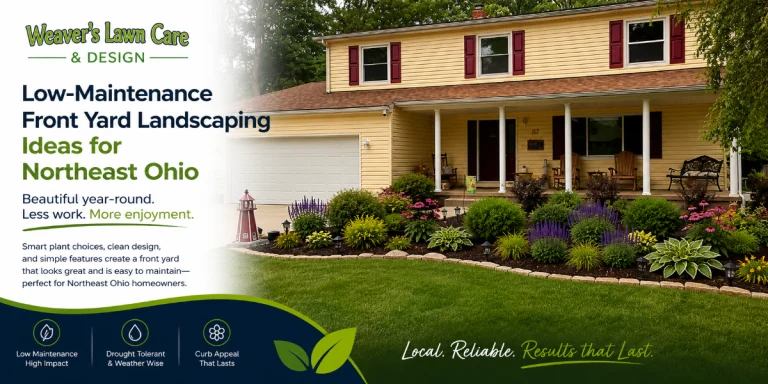
A few appropriately sized evergreens mixed with flowering shrubs, grasses, and perennials usually create a more interesting landscape than a solid row of identical shrubs. Boxwoods and other compact evergreens can work well when the variety and location are chosen carefully.
Evergreens are particularly useful for:
-
- Adding winter structure near entrances
- Anchoring mixed planting beds
- Creating contrast behind flowering plants
- Providing screening where year-round coverage is needed
They are not maintenance free. Even well-selected shrubs can benefit from occasional professional shrub trimming, but choosing varieties that naturally fit the available space can greatly reduce how often that needs to happen.
A simpler plant palette is usually easier to maintain
One of the easiest ways to make landscaping unnecessarily complicated is to plant too many different things.
This often happens when landscaping is installed a little at a time. A homeowner buys a shrub one year, adds three different perennials the next year, fills another opening with something else, and eventually ends up with a bed containing a dozen plants that have very little relationship to each other.
A simpler design might use:
-
- One or two main shrub varieties
- Groups of the same perennial repeated through the bed
- A few ornamental grasses for texture
- One or two accent plants where something different is needed
This tends to look better and is easier to understand when it comes time for pruning and seasonal cleanup. Simplifying an overcrowded planting scheme is often an important part of our overgrown garden bed renovations.
Give plants enough room to grow
This might be the most important low-maintenance landscaping advice we can give: stop planting shrubs based on how small they look when you buy them.
A three-gallon shrub can look tiny against a house, and it is tempting to plant several of them close together so the bed looks full immediately. Five years later, those same shrubs may be growing into each other, covering windows, hanging over the sidewalk, and requiring constant trimming.
Proper spacing means thinking about:
-
- The mature width of each shrub
- Distance from the foundation
- Clearance around windows, steps, and walkways
- How neighboring plants will grow together
A newly installed landscape may look slightly more open at first when plants are spaced properly. That is normal. The goal of a professional landscape installation is not just to make the property look good on installation day. It should still make sense after the plants have had several years to grow.
Good garden beds make the plants easier to maintain
Low-maintenance landscaping is not only about what you plant. The shape and condition of the garden beds also make a difference.
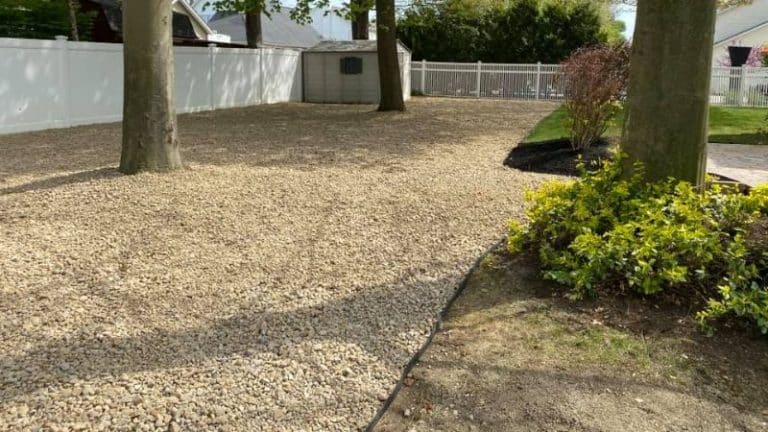
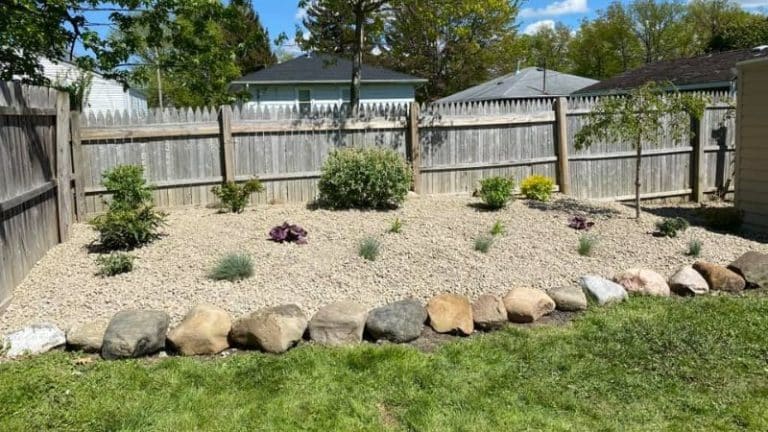
Beds with awkward corners can be frustrating to mow around. Plants installed too close to the lawn quickly spill over the edge. Bare soil leaves plenty of room for weeds. Old landscape rock and fabric can make future planting more difficult than it needs to be.
When renovating beds, we look at the entire planting area rather than simply finding empty spots for new plants.
A practical garden bed should have:
-
- Clean edges that work with the surrounding lawn
- Enough depth for plants to grow without crowding the house
- Space between plants based on mature size
- A consistent layer of mulch to help manage weeds and moisture
Professional mulch installation can finish the renovated beds and make ongoing maintenance more manageable. It is a simple part of the project, but it makes a big difference in how finished the landscaping looks.
Choose a Lake County landscaper who plans for what happens five years from now
The best low-maintenance plants for your neighbor's house may not be the best plants for yours. The amount of sunlight, drainage, available space, existing trees, wildlife pressure, and style of the home all change what makes sense.
Weaver's Lawn Care & Design is a locally owned, husband-and-wife operated company providing residential landscaping services throughout Lake County and surrounding Northeast Ohio communities. Bob Weaver manages operations, crews, and client relationships, while co-owner Jessica leads the landscape design side of the business.
When we plan a landscape, we are not only looking at how the plants will look when they go into the ground. We are thinking about how large they will become, which plants will provide color at different times of year, what the property will look like during winter, and how much work the homeowner wants to put into maintaining it.
That is particularly important when renovating an older landscape. If the existing shrubs have become a constant maintenance problem, the new design should solve that problem rather than starting the same cycle over again.
Proudly serving homeowners throughout Lake County and Northeast Ohio
Weaver's Lawn Care & Design provides landscape design, planting, garden bed renovation, landscape lighting, lawn care, and property maintenance throughout our Northeast Ohio service area, including:
-
- Madison
- Perry
- Geneva
- Mentor
- Painesville
- Concord
- Chardon
- Kirtland
- Eastlake
- Wickliffe
- Willowick
Landscaping in Northeast Ohio has to deal with hot summer stretches, cold winters, spring rain, mature trees, and a relatively short growing season. Plants that are well suited to those conditions will usually perform better and require less intervention than plants chosen mainly because they looked good at the garden center.
For homeowners who want even less work, Weaver's can also provide ongoing landscape maintenance along with mulch, shrub pruning, lawn care, seasonal cleanups, and other services needed to keep the property looking good.
Ready to make your landscaping easier to live with?
There is no single plant list that will create a low-maintenance yard on every property. Hydrangeas may be perfect in one bed and completely wrong in another. Hostas can thrive along one side of a house while deer make them impractical somewhere else. Ninebark can be an excellent low-maintenance shrub when it has room to grow and a constant pruning problem when it does not.
The best results come from looking at the property as a whole and choosing plants for the places where they will actually live.
If your current landscaping has become overgrown, dated, or simply takes more work than you want to give it, you do not necessarily need to tear everything out. Some existing plants may be worth keeping, while others can be replaced with better choices. Bed shapes can be improved, crowded areas can be simplified, and new plants can be selected with their mature size in mind.
Contact Weaver's Lawn Care & Design to request a landscape evaluation and estimate for a low-maintenance landscape, new planting design, or garden bed renovation in Perry, Madison, Mentor, Painesville, Concord, Kirtland, Chardon, Geneva, or the surrounding Northeast Ohio area.