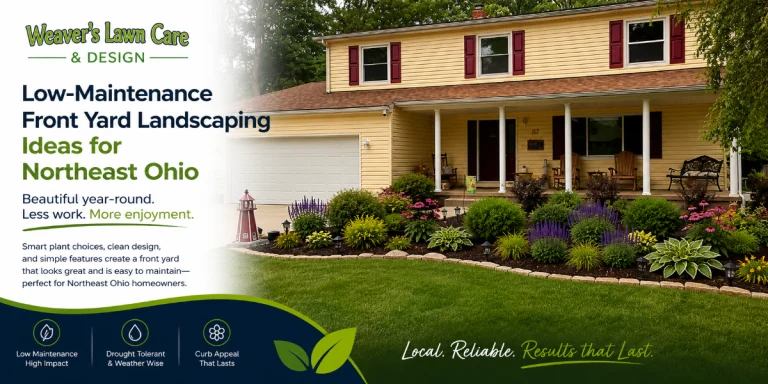
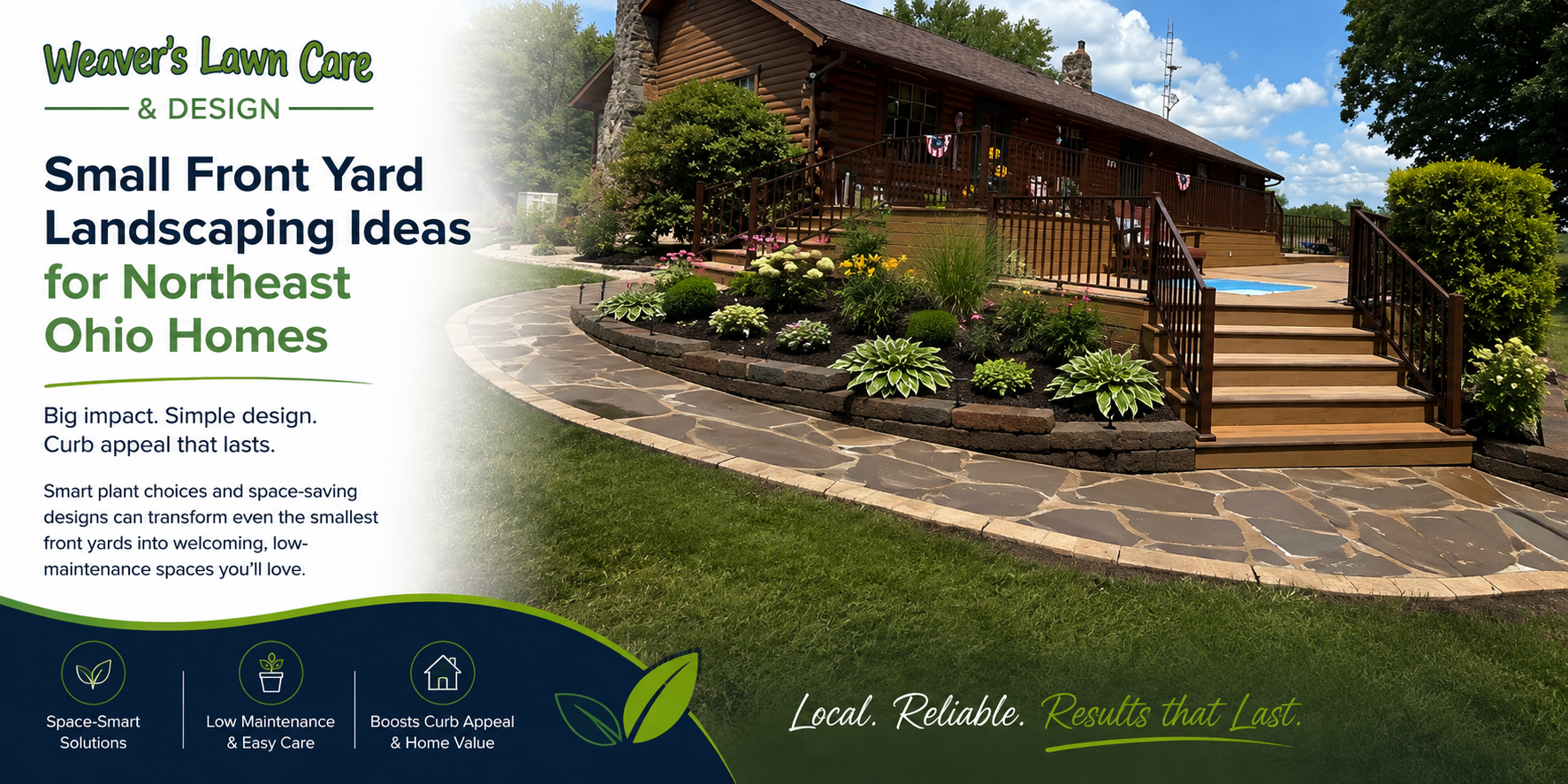
Small Front Yard Landscaping Ideas for Northeast Ohio
A small front yard can be easier to landscape than a large one, but there is less room for mistakes. One oversized shrub can cover a window. A garden bed that extends too far into the lawn can make the property feel cramped. Too many different plants can turn a simple front yard into a busy collection of competing shapes and colors.
The goal is not to fit as much landscaping as possible into the available space. It is to decide where landscaping will have the most impact and use plants that are properly scaled to the house and yard.
At Weaver's Lawn Care & Design, we design and renovate residential landscapes throughout Lake County and surrounding Northeast Ohio communities. Smaller front yards are common throughout established neighborhoods in Mentor, Painesville, Wickliffe, Willowick, Eastlake, and other communities closer to the lake, and they often need a different approach than larger properties in more rural parts of the region.
Whether you are starting with an overgrown landscape or an almost blank front yard, these ideas can help you get more from a smaller space without making it feel crowded.
Start by deciding what the front yard actually needs
Before choosing plants, step across the street and look at the house as a whole. In a small yard, every part of the landscape is visible at once, so the overall composition matters more than filling individual empty spaces.
Ask what is currently missing. Does the entrance need more attention? Are the foundation beds too narrow? Is one oversized shrub dominating the house? Does the yard simply need more color?
A professional landscape design can help establish priorities before plants start going into the ground.
A small front yard may only need:
-
- A better-defined foundation bed
- Several appropriately sized shrubs
- A few groups of flowering perennials
- One strong focal point near the entrance
Keeping the plan focused usually makes a smaller property feel larger and more organized.
Remove oversized foundation shrubs before designing around them
Older landscaping can consume a surprising amount of space. Yews, junipers, arborvitae, and other shrubs that have been growing for decades may extend several feet farther into the yard than they did when originally planted.
On a large property, an oversized shrub may simply look overgrown. In a small front yard, it can visually take over the entire space.
During a garden bed renovation, it is worth asking whether each mature plant still deserves the space it occupies.
Removal may make sense when:
-
- A shrub repeatedly grows over a window
- Plants have narrowed the walkway or crowded the porch
- Heavy pruning is needed several times a year
- The existing landscaping makes the house feel smaller or hidden
Healthy plants that still fit can certainly stay. The goal is to reclaim space from plants that no longer work with the property.
Keep foundation beds proportional to the house
There are two common mistakes with garden beds in small front yards. Some are so narrow that every shrub is squeezed against the foundation. Others have been expanded so aggressively that very little usable lawn remains.
The right answer is somewhere in between.
A properly planned front yard landscape should give plants enough room to grow while maintaining reasonable proportions between the house, garden beds, walkway, driveway, and lawn.
A good bed layout should:
-
- Provide enough depth for mature plants
- Leave comfortable clearance from the house
- Use simple curves or lines that are easy to maintain
- Avoid unnecessarily cutting the lawn into small pieces
Sometimes adding another foot or two of bed depth makes the planting work much better. That does not mean turning the entire front yard into a garden.
Choose compact shrubs that will stay below the windows
Plant size matters on every property, but it is especially important when the front yard is small.
A shrub that naturally wants to become six feet tall should not be planted below a three-foot-high window and expected to behave through constant pruning. There are plenty of smaller cultivars that can provide flowers, foliage, and structure without overwhelming the house.
Depending on the growing conditions, a planting design might use:
-
- Compact panicle hydrangeas
- Smaller spirea varieties
- Appropriately sized evergreen shrubs
- Low-growing perennials where a shrub is not needed
Choosing plants for their mature dimensions can also dramatically reduce future maintenance. You should not have to reshape the landscaping every few weeks simply to keep your windows visible.
Use fewer plant varieties and repeat them
Small front yards usually benefit from restraint.
If you install one hydrangea, one spirea, one ornamental grass, one evergreen, one coneflower, one hosta, and six other unrelated plants, the landscape can quickly feel like a collection rather than a design.
Repeating a smaller number of plants creates continuity.
For example, a simple landscape installation might combine:
-
- Three compact flowering shrubs
- Several small evergreens used in key locations
- Two perennial varieties repeated in groups
- One ornamental grass used as an accent
You still get different heights, textures, and flowering periods without making the front yard visually cluttered.
Put more emphasis around the front entrance
When space is limited, you do not need equal amounts of landscaping everywhere. Concentrating some of the strongest planting around the entrance can give the front yard a clear focal point.
That might mean using flowering shrubs near the porch, repeating a perennial along the walkway, or placing an attractive evergreen where it helps frame the front door.
Entry landscaping should:
-
- Lead your eye toward the front door
- Leave steps and walkways comfortably open
- Complement the porch rather than hide it
- Provide interest without creating a wall of plants
This is something we can account for during a front yard landscape design. On a smaller property, improving one important focal area can have more impact than adding plants across every available section of the yard.
Use flowering shrubs to get more from individual plants
Every plant occupies valuable space in a small front yard, so it helps when a plant contributes more than one thing to the landscape.
Flowering shrubs can provide structure for much of the growing season while also producing a strong period of color. That makes them particularly useful where there is not room for large perennial gardens.
Compact hydrangeas and spirea are two examples that may work well in the right conditions.
Flowering shrubs can be used:
-
- Below or between windows when properly sized
- Beside the front entrance
- As repeated plants through a foundation bed
- Behind lower perennials for a layered appearance
A front garden bed makeover is a good opportunity to replace older shrubs that provide little seasonal interest with plants that contribute more without occupying additional space.
Use perennials for color without creating a large flower garden
A small front yard can have plenty of flowers without turning into a complicated perennial garden.
Instead of planting many individual varieties, use a few dependable perennials in groups. Repetition makes the flowers more noticeable from the street and simplifies seasonal maintenance.
Depending on sunlight and site conditions, options might include:
-
- Catmint in sunny planting areas
- Black-eyed Susans for summer color
- Purple coneflower in sunny, pollinator-friendly beds
- Hostas where shade conditions are appropriate
Once planted, fresh mulch can define those groups and give the intentionally open areas between young plants a clean appearance while they grow.
Add one ornamental grass for contrast
When every plant has a similar rounded form, even a simple landscape can start to feel heavy. One or two ornamental grasses can introduce finer texture and movement without requiring much additional space.
The important part is choosing a grass that fits the scale of the property. A large grass that spreads several feet across can overwhelm a shallow foundation bed.
Smaller ornamental grasses can work:
-
- Between groups of flowering shrubs
- Near a corner where a little extra height is useful
- Alongside flowering perennials
- As a repeated accent in a sunny garden bed
Many grasses primarily require a seasonal cutback rather than repeated shaping throughout the year. Weaver's also provides seasonal yard cleanup for homeowners who prefer to have spring and fall landscape cleanup handled professionally.
Be careful with ornamental trees in a small front yard
An ornamental tree can be a great focal point, but not every small front yard needs one.
Before adding a tree, consider what is already nearby. Street trees, mature shade trees, utility lines, the driveway, neighboring properties, and the house itself can leave less growing room than it initially appears.
Where there is adequate space, a small ornamental tree can provide:
-
- Spring flowers
- Additional height without another large shrub mass
- Fall color
- A focal point away from the foundation
A professional landscape plan can determine whether a tree will improve the yard or simply make an already small space feel more crowded. Sometimes the better choice is keeping the planting lower and preserving a more open view of the house.
Use native plants selectively in smaller spaces
Native plants can work very well in small Northeast Ohio front yards, but plant selection becomes especially important when space is limited.
Some native shrubs and perennials can become fairly large or spread beyond their original locations. Others are much easier to incorporate into a clean residential landscape.
Native options worth considering may include:
-
- Little bluestem for upright texture
- Black-eyed Susans for summer flowers
- Purple coneflower for pollinator-friendly color
- Compact native selections suited to the specific site
A landscape renovation can mix native plants with well-suited ornamental varieties rather than forcing every plant into one category. For most homeowners, the more important question is whether each plant fits the space and growing conditions.
Do not eliminate the lawn just because the front yard is small
It can be tempting to turn a small front yard into one large planting bed, especially when homeowners are trying to reduce mowing. That does not always make the property easier to maintain.
A simple area of healthy lawn can provide valuable open space between the house and street. It also gives the eye somewhere to rest between planting areas.
Keeping some lawn can:
-
- Make the front yard feel more open
- Create contrast with garden beds
- Provide a clean foreground for the house
- Reduce the amount of planting that needs seasonal care
Because Weaver's provides both residential landscaping and lawn care, the goal does not have to be maximizing one at the expense of the other. A balanced combination can often make the most sense for a smaller lot.
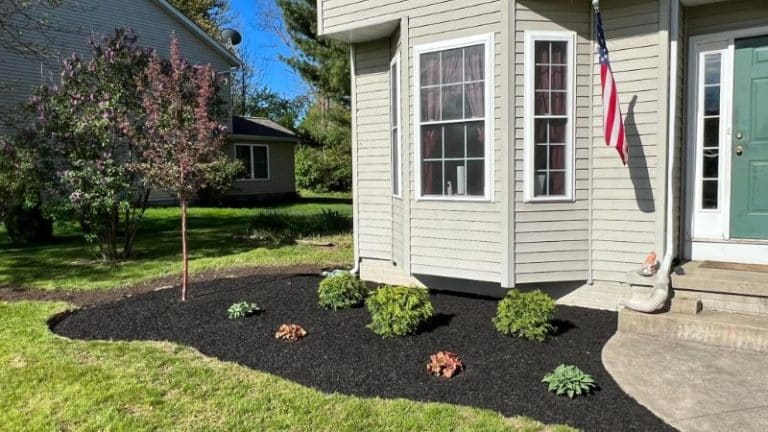
Use clean bed edges and mulch to make the yard feel organized
Small yards tend to show details more clearly. Messy bed edges, weeds, exposed soil, and uneven mulch are harder to overlook when everything is close together.
Fortunately, you do not need additional plants to solve those problems.
A finished garden bed should have:
-
- Clean edges between the lawn and planting areas
- Consistent mulch coverage
- Enough open space for plants to mature
- Simple shapes that are easy to mow around
Professional mulch installation can make a relatively simple planting look much more finished. It also means you do not need to overcrowd a new bed just to cover visible soil.
Use landscape lighting to make a simple yard more interesting at night
One advantage of a smaller front yard is that you may only need a few well-positioned lights to make a noticeable difference.
Instead of adding more landscaping, lighting can draw attention to the strongest plants and architectural features already there.
Professional landscape lighting might be used to:
-
- Highlight a small ornamental tree
- Improve visibility along the front walkway
- Bring attention to the front entrance
- Add depth to a simple foundation planting
Lighting is particularly easy to consider when garden beds are already being renovated because fixture placement can be coordinated with the new plants.
Keep narrow side areas connected to the front yard
On smaller properties, the space between the house and driveway or between the house and property line may be visible from the street. Ignoring these areas can make a renovated front yard feel unfinished.
That does not mean they need elaborate planting.
A narrow area might only need:
-
- A continuation of the same mulch bed
- Several repeated shrubs or perennials
- A simple transition toward the backyard
- Plants selected specifically for the available sunlight and width
When Weaver's plans a garden bed renovation, these smaller transition areas can be considered along with the main foundation landscaping so the property feels connected rather than pieced together.
A small front yard can still justify a professional landscape renovation
A smaller property does not necessarily mean there is very little work involved. Removing mature shrubs, changing garden bed shapes, preparing soil, installing new plants, and finishing everything with mulch still requires planning and labor.
The advantage is that a smaller area can allow more of the budget to be concentrated where homeowners see it every day.
A professional renovation might address:
-
- Removal of old foundation shrubs
- Redesign of the main front garden beds
- New shrubs, grasses, and perennial plantings
- Mulch and optional landscape lighting
Weaver's landscape renovation services are especially useful when an older small yard has become dominated by plants that no longer fit. Rather than making small fixes around those plants, the space can be reconsidered as a whole.
Choose a Northeast Ohio landscaper who understands scale
Good landscaping on a small lot is often about knowing when to stop. There should still be open space around the plants, clear views toward the entrance, and enough room for the landscape to mature without taking over the property.
Weaver's Lawn Care & Design is a locally owned, husband-and-wife operated company providing residential landscaping and landscape renovation throughout Lake County and surrounding Northeast Ohio communities. Bob Weaver manages operations, crews, and client relationships, while co-owner Jessica leads the landscape design side of the business.
When we evaluate an existing front yard, we can look at which mature plants are worth preserving, which ones have become too large, how the garden beds relate to the house, and where new landscaping will have the greatest impact.
For a smaller property, that can be more valuable than simply adding more. The goal is to make better use of the space you already have.
Proudly serving homeowners throughout Lake County and Northeast Ohio
Weaver's Lawn Care & Design provides landscape design, garden bed renovation, planting, landscape lighting, mulch, lawn care, and property maintenance throughout our Northeast Ohio service area, including:
-
- Madison
- Perry
- Geneva
- Mentor
- Painesville
- Concord
- Chardon
- Kirtland
- Eastlake
- Wickliffe
- Willowick
Small front yards are especially common in established Lake County neighborhoods where homes, driveways, sidewalks, mature trees, and neighboring properties can all compete for limited space. A successful design needs to account for those constraints instead of using the same planting plan that might work on a much larger lot.
Along with front garden bed renovations, Weaver's can help with landscape design, new plantings, mulch, shrub trimming, landscape lighting, seasonal cleanup, lawn care, and ongoing landscape maintenance.
Ready to make better use of your small front yard?
You do not need a large property to create a front yard that has strong curb appeal. On a smaller lot, a few well-chosen changes can actually have a bigger visual impact because the landscaping is so closely connected to the house.
The most successful small front yards usually have a clear plan: remove plants that have outgrown the space, keep mature landscaping that still works, use appropriately sized shrubs, repeat a smaller number of plants, and leave enough open space for everything to breathe.
If your existing front yard feels crowded, dated, or difficult to maintain, avoid trying to solve the problem one plant at a time. An evaluation of the entire space can show where your landscaping budget will have the greatest impact and help prevent the new plants from creating the same problems as the old ones.
Contact Weaver's Lawn Care & Design to request a landscape evaluation and estimate for a small front yard makeover, garden bed renovation, or new landscape design in Perry, Madison, Mentor, Painesville, Concord, Kirtland, Chardon, Geneva, or the surrounding Northeast Ohio area.