Best Native Plants for Lake County, Ohio Front Yards
Native plants are a natural fit for homeowners who want a front yard that feels connected to Northeast Ohio without looking wild or unplanned. Used well, native trees, shrubs, grasses, and flowering perennials can give a landscape plenty of color and texture while also supporting pollinators and other local wildlife.
The key is using the right plants in the right places. Being native to Ohio does not automatically make a plant appropriate beside your front porch or underneath a window. Some native shrubs become quite large, some perennials spread aggressively, and others need specific amounts of sun or moisture to perform well.
At Weaver's Lawn Care & Design, we design and renovate landscapes throughout Lake County and surrounding Northeast Ohio communities. For homeowners interested in native plants, we generally recommend thinking about them as part of the overall front yard rather than trying to make every plant native simply for the sake of it.
A few well-chosen native plants can work beautifully alongside traditional landscape plants. The result can still look clean, intentional, and appropriate around the house while bringing more of Northeast Ohio into the landscape.
For homeowners in Perry, Madison, Mentor, Painesville, Concord, Kirtland, Chardon, Geneva, and nearby communities, here are some native plants worth considering for a front yard.
Start with the conditions around your house, not a list of native plants
Before choosing individual plants, look at where they are going to live. Front yards can have surprisingly different growing conditions within a relatively small area. A south- or west-facing foundation bed may receive intense afternoon sun, while the opposite side of the house stays shaded and cool for most of the day.
Soil moisture can vary just as much. One bed may dry quickly while another stays wet after Northeast Ohio's heavier spring and summer rains.
A professional landscape design should consider:
-
- How much direct sunlight the planting area receives
- Whether the soil tends to stay wet or drain quickly
- How much room is available as plants mature
- How formal or natural you want the finished landscape to look
Native plants are often described as lower maintenance, but that is only true when they are suited to the site. A sun-loving native planted in deep shade can struggle just like any other plant.
Ninebark is a useful native shrub when you have enough room
Ninebark is one of the easiest native shrubs to incorporate into a more traditional residential landscape. It has an attractive natural form, spring flowers, interesting bark, and varieties are available with foliage ranging from green to deep burgundy.
That darker foliage can be particularly useful in front yards where almost everything else is green. It creates contrast without relying entirely on flowers.
Ninebark can work well:
-
- Near a larger corner of the house
- Toward the back of a deep garden bed
- As a backdrop for lower flowering perennials
- In a more natural or mixed planting design
Size is the main consideration. Some ninebark varieties can become substantial shrubs and should not be squeezed underneath a low window. During a garden bed renovation, we can look at whether the existing beds provide enough room or should be expanded before larger shrubs are introduced.
Serviceberry can be an excellent native ornamental tree
If a front yard needs height, an ornamental tree can sometimes do more for the design than adding another group of shrubs.
Serviceberry is native to the region and provides interest through several seasons. It produces white flowers in spring, berries later in the season, fall foliage, and attractive branching that remains visible after the leaves drop.
Serviceberry can be considered:
-
- As a focal point within a larger front garden bed
- Near a corner of the house where there is adequate room
- As part of a layered native planting
- Where the landscape needs more height and seasonal interest
Placement is important because even a smaller tree needs room for its canopy and roots. Weaver's landscape design services can account for the house, windows, walkways, driveway, existing trees, and mature plant size before deciding where a serviceberry or another ornamental tree belongs.
Red chokeberry provides flowers, fruit, and fall color
Red chokeberry is another native shrub that can bring more than one season of interest to a Lake County front yard. It produces spring flowers, fruit, and strong fall color, making it useful when the goal is to get more from each plant than a few weeks of bloom.
Its natural appearance works particularly well in landscapes that are a little less formal.
Red chokeberry can be used:
-
- In mixed shrub borders
- In larger foundation beds with sufficient space
- As part of a pollinator- and wildlife-friendly landscape
- With ornamental grasses and flowering perennials
It should still be selected with mature size in mind. One of the goals of a professional landscape installation is to avoid putting homeowners in a position where naturally larger shrubs have to be aggressively pruned every year just to fit the available space.
Virginia sweetspire can work well in damper planting areas
Some Lake County properties have planting beds that hold more moisture than others, especially in lower areas or locations where water naturally moves after rain. Instead of continually fighting those conditions, it can make sense to choose plants that are more comfortable with them.
Virginia sweetspire is a native shrub that can tolerate moist conditions while providing flowers and attractive fall foliage.
Depending on the property, it can work:
-
- In lower portions of larger planting beds
- In areas that receive more consistent moisture
- As part of a mixed shrub and perennial planting
- Where fall foliage is an important part of the design
Persistently wet soil should still be evaluated rather than automatically planted around. If standing water or saturated soil is the result of a larger property issue, that needs to be understood before beginning a new garden bed renovation.
Black-eyed Susans are an easy way to bring native summer color into the front yard
You do not need to redesign the entire yard as a native garden to start incorporating native plants. Black-eyed Susans are an easy example of a familiar flowering plant that fits comfortably into many conventional front landscapes.
Their bright yellow flowers can provide a strong block of summer color, particularly when several plants are grouped together rather than scattered individually through the bed.
They work particularly well:
-
- In sunny front garden beds
- In groups between larger shrubs
- Alongside ornamental grasses
- In pollinator-friendly planting areas
A good planting design can combine summer bloomers with plants that provide spring flowers, fall color, and winter structure. That keeps the landscape interesting for much longer than choosing everything based on what happens to be flowering at the nursery on one particular weekend.
Purple coneflower fits naturally into sunny Northeast Ohio landscapes
Purple coneflower is another native perennial that works well when homeowners want flowers without creating a formal annual bed. Its recognizable flowers provide summer interest and can attract pollinators.
Coneflowers generally look better when repeated in groups. A single plant can disappear visually among larger shrubs, while several together create a noticeable patch of color.
Consider coneflowers:
-
- In sunny perennial borders
- Near the front or middle of deeper garden beds
- Alongside black-eyed Susans and ornamental grasses
- In landscapes intended to attract more pollinators
Perennials still require seasonal cleanup, so native does not mean maintenance free. Combining them with properly prepared beds and professional mulch installation can help keep the planting areas cleaner and reduce exposed soil where weeds can become established.
Bee balm can add strong color where there is room for it
Bee balm is a recognizable native perennial with distinctive flowers that are attractive to pollinators. It can be a great plant in the right setting, but it is also a good example of why homeowners should understand how a native plant behaves before putting it beside the front door.
Some varieties can spread and create a looser, more natural appearance. That can be excellent in a larger perennial bed but less desirable in a small, tightly controlled foundation planting.
Bee balm is better suited to:
-
- Larger sunny planting areas
- Naturalistic perennial beds
- Pollinator gardens
- Areas where some spreading is acceptable
During a landscape renovation, plants like bee balm can be placed where their natural growth habit contributes to the design rather than becoming something the homeowner has to constantly control.
Switchgrass can bring native texture and movement to larger beds
Ornamental grasses are useful in front landscapes because they break up the rounded shapes of traditional shrubs. Switchgrass is native and can provide upright structure, movement, and late-season interest.
There are different cultivars available, so mature size and growth habit should be considered carefully. In the right location, switchgrass can become an excellent background or accent plant.
It can work well:
-
- In deeper foundation beds
- Near corners where additional height is useful
- Behind lower flowering perennials
- In more natural front yard designs
Grasses are generally cut back once a year rather than continually shaped throughout the growing season. For homeowners who would rather have seasonal work handled professionally, Weaver's also provides seasonal yard cleanup services.
Little bluestem is a better grass for smaller spaces
Not every front yard has room for a large ornamental grass. Little bluestem offers a more compact native option while still bringing fine texture, upright growth, and changing color later in the season.
It can be especially useful when a front landscape needs something different between flowering shrubs and perennials but does not have room for another substantial plant.
Little bluestem can be used:
-
- In sunny, well-drained planting areas
- Repeated through larger perennial beds
- Alongside native flowering plants
- Where a more natural look is wanted without excessive height
It can also help provide visual interest after many summer flowers have finished. Incorporating plants with different peak seasons is something we consider when developing a complete landscape plan.
Wild geranium can be useful in partially shaded front yards
Native planting is not limited to full-sun properties. Wild geranium is one option worth considering in areas that receive partial shade, particularly around homes with established trees.
Its spring flowers and foliage can work nicely in a more natural planting underneath larger shrubs or around the edges of wooded areas.
Wild geranium can make sense:
-
- In partially shaded garden beds
- Around established trees where conditions are suitable
- With other woodland-style plants
- As part of a softer, more natural bed edge
Shade conditions around older homes can change significantly as trees mature. When Weaver's evaluates an existing overgrown garden bed, we look at the sunlight available now rather than assuming the plants that worked there 15 years ago are still the right choices.
Native plants do not have to make your front yard look wild
Some homeowners like the idea of native plants but worry that the front of their house will end up looking like an unmanaged meadow. It does not have to.
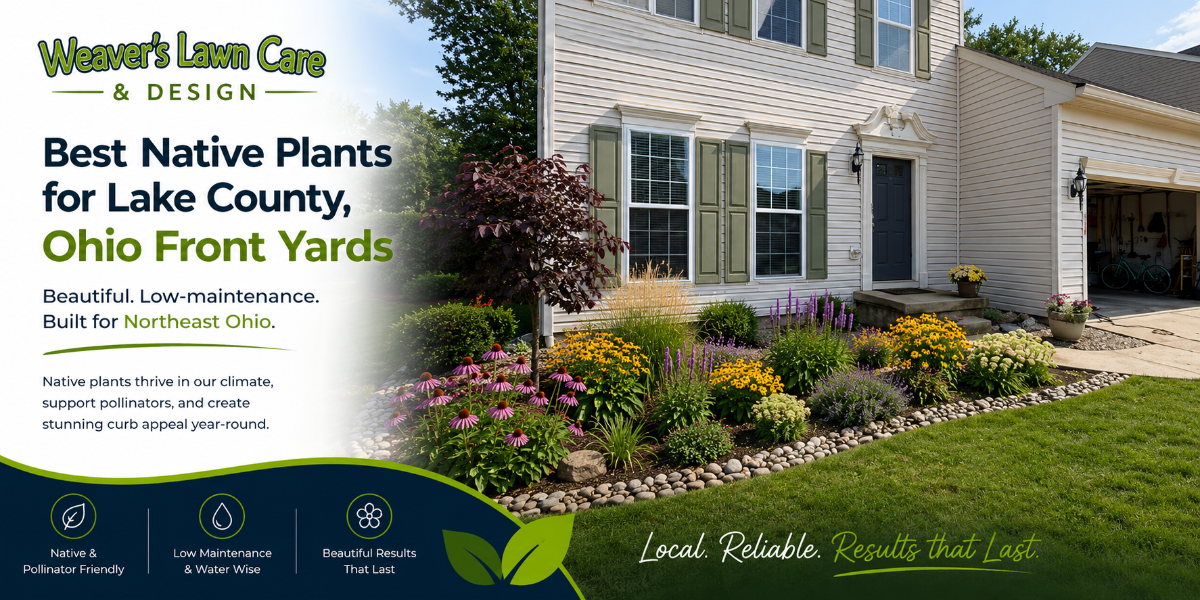
Native plants can be used within a traditional residential landscape just like any other plant. Clean bed lines, repetition, appropriate spacing, mulch, and a clear arrangement of taller and shorter plants can give the front yard plenty of structure.
A more organized native planting might include:
-
- A serviceberry as an ornamental focal point
- Several ninebarks or another shrub repeated through larger areas
- Groups of coneflower or black-eyed Susans for color
- Little bluestem repeated between flowering plants
The finished appearance depends as much on the layout as the individual species. A professional residential landscaping plan can use native plants without losing the clean, finished appearance most homeowners want around the front of their house.
You do not need to make every plant native
There is also nothing wrong with mixing native plants with well-behaved ornamental plants that perform reliably in Northeast Ohio.
For many homeowners, this produces the best balance. Native plants can be used where they make sense for pollinators, seasonal interest, or a more natural appearance, while other landscape plants provide particular flower colors, compact sizes, or evergreen structure.
A mixed front landscape might combine:
-
- Native serviceberry or ninebark for structure
- Panicle hydrangeas for dependable summer flowers
- Native coneflowers and black-eyed Susans for perennial color
- Compact evergreens for winter structure
This approach gives a landscape designer more flexibility to choose the right plant for each location rather than forcing a plant into a space simply because it is native.
Give native plants enough room to grow naturally
One of the advantages often associated with native plants is reduced maintenance, but that advantage disappears quickly if they are planted in spaces that are too small.
Ninebark planted underneath a low window can still require constant pruning. A spreading perennial planted beside a narrow walkway can still become annoying. A large grass placed in the front of a shallow bed can still overwhelm everything around it.
Good spacing should consider:
-
- The mature width and height of each plant
- Distance from windows, siding, and the foundation
- Clearance around walkways and steps
- How neighboring plants will grow together
Professional landscape installation plans for what plants will become instead of trying to make the bed look completely full on installation day. Giving plants enough space now can prevent a lot of unnecessary pruning and removal later.
Use mulch and clean bed edges to keep native plantings looking intentional
The garden bed itself can make a major difference in how a native planting is perceived.
A group of coneflowers and grasses growing in an undefined patch of lawn can look accidental. Put those same plants in a clearly shaped, properly mulched garden bed and the result immediately feels more deliberate.
A finished native planting can benefit from:
-
- Clean, easy-to-maintain garden bed edges
- Enough bed depth for layered plantings
- Consistent mulch between young plants
- Repeated plant groups rather than random individual plants
Weaver's provides professional mulch installation as part of larger landscape improvements. Mulch is particularly useful during the first few years of a new planting when intentionally spaced plants have not yet reached their mature size.
Choose a Lake County landscaper who can mix native plants into the whole design
A successful native landscape is not created by purchasing a collection of Ohio plants and finding empty places to put them. The individual plants still need to work with the house, the garden beds, the existing landscape, and each other.
Weaver's Lawn Care & Design is a locally owned, husband-and-wife operated company providing residential landscaping and garden bed renovation throughout Lake County and surrounding Northeast Ohio communities. Bob Weaver manages operations, crews, and client relationships, while co-owner Jessica leads the landscape design side of the business.
For an existing front yard, that process can begin by evaluating what is already there. Some established plants may fit perfectly well with a new native-inspired design. Others may have become oversized, unhealthy, or poorly suited to the property and are better removed.
From there, native plants can be introduced where they make sense rather than forcing the entire landscape into one category. The result can feel distinctly Northeast Ohio while still looking appropriate around a well-maintained home.
Proudly serving homeowners throughout Lake County and Northeast Ohio
Weaver's Lawn Care & Design provides landscape design, garden bed renovation, planting, landscape lighting, mulch, lawn care, and property maintenance throughout our Northeast Ohio service area, including:
-
- Madison
- Perry
- Geneva
- Mentor
- Painesville
- Concord
- Chardon
- Kirtland
- Eastlake
- Wickliffe
- Willowick
Lake County landscapes have to handle real seasonal changes, from wet springs and warm summers to freezing winter temperatures. Native plants are worth considering because they are part of this regional environment, but they still need to be chosen for the specific conditions around your home.
Weaver's can incorporate native plants into a larger garden bed renovation along with ornamental plants, mulch, shrub trimming, landscape lighting, seasonal cleanup, lawn care, and ongoing landscape maintenance.
Have your front yard evaluated before choosing native plants
Ninebark, serviceberry, red chokeberry, Virginia sweetspire, black-eyed Susans, purple coneflower, bee balm, switchgrass, little bluestem, and wild geranium can all have a place in Lake County landscapes. That does not mean all ten belong in the same yard.
The best native planting starts with the property. A sunny, open front yard in Madison may call for a very different plant combination than a shaded property in Kirtland or an established neighborhood lot in Mentor.
If your current front landscaping is overgrown or outdated, the project also does not necessarily need to begin by removing everything. Existing ornamental trees, evergreens, flowering shrubs, and other healthy plants can sometimes stay while native plants are introduced around them.
The goal should be a front landscape that looks like it belongs with your home, provides interest through several seasons, and uses plants that have enough room and the right conditions to perform well over the long term.
Contact Weaver's Lawn Care & Design to request a landscape evaluation and estimate for a native-inspired front yard, new planting design, or garden bed renovation in Perry, Madison, Mentor, Painesville, Concord, Kirtland, Chardon, Geneva, or the surrounding Northeast Ohio area.