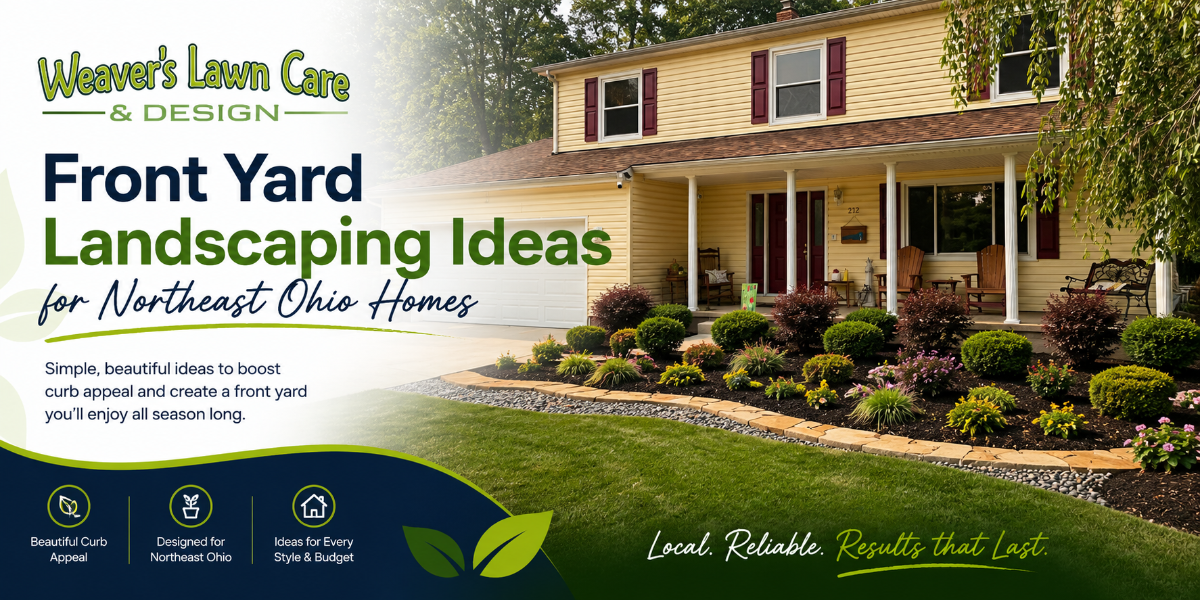
Front Yard Landscaping Ideas for Northeast Ohio Homes
Your front yard does a lot more than fill the space between your house and the street. It frames the home, guides people toward the entrance, and has a major influence on how the entire property feels when you pull into the driveway.
For many Northeast Ohio homeowners, the challenge is that the landscaping was installed years ago and has gradually lost its shape. Foundation shrubs have grown over windows, trees have become too large for their locations, garden beds have filled in unevenly, and plants that once looked good together no longer work as a group.
At Weaver's Lawn Care & Design, we design and renovate residential landscapes throughout Lake County and surrounding Northeast Ohio communities. Front yard projects are a large part of that work because homeowners often want to improve curb appeal without completely rebuilding their property.
A good front yard renovation does not need to be complicated. In many cases, the biggest improvements come from simplifying what is already there, choosing plants that fit the house, creating better garden bed shapes, and giving the landscape enough variety to look interesting from spring through fall.
Here are some front yard landscaping ideas that work particularly well for homes in Perry, Madison, Mentor, Painesville, Concord, Kirtland, Chardon, Geneva, and the surrounding Northeast Ohio area.
Start by removing landscaping that has clearly outgrown the house
Before deciding what to add, take a hard look at what should come out. Older foundation landscapes often contain shrubs that have been repeatedly trimmed for years simply because they are much larger than the space allows.
You may see yews covering the bottoms of windows, junipers spreading into sidewalks, shrubs blocking the porch, or small ornamental trees that are now competing with the house. Continually cutting these plants back rarely solves the underlying problem.
A professional garden bed renovation can identify plants worth keeping while removing the ones that are making the front yard feel crowded or dated.
Plants are usually worth reconsidering when:
-
- They regularly grow over windows or walkways
- Heavy pruning is required just to keep them in place
- They are declining, damaged, or poorly shaped
- They no longer fit the style of the new landscape
You do not necessarily need to remove everything. A healthy ornamental tree or well-positioned mature shrub can give a renovated landscape an established appearance from day one. The goal is to keep plants because they contribute to the design, not simply because they are already there.
Use larger garden beds instead of squeezing plants against the foundation
Many older homes have narrow planting beds running along the foundation with shrubs packed tightly between the house and lawn. Those beds can make it difficult to use plants with different heights and textures, and they often contribute to shrubs being planted too close to the house.
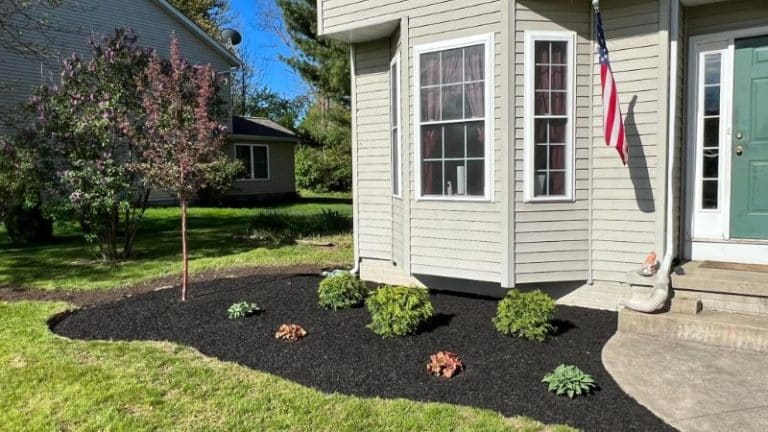
Expanding or reshaping the beds can completely change the appearance of the front yard without changing anything about the house itself.
A larger bed creates room for:
-
- Layered shrubs and perennials
- Small ornamental trees
- Curved or more natural bed lines
- Plants with enough space to reach mature size
When Weaver's develops a front yard landscape design, we can look at the proportions of the house, driveway, walkway, lawn, and existing beds together. A ranch home may benefit from a different planting layout than a tall two-story house, and a large rural property may call for a different scale than a smaller neighborhood lot.
Create layers instead of planting one row of shrubs
A single row of identical shrubs can certainly be neat, but it rarely creates the depth homeowners are looking for when updating an older front yard.
Layering plants creates a much more finished appearance. Taller plants can establish the background, medium-sized shrubs provide structure through the middle of the bed, and smaller perennials or grasses soften the front edge.
A simple layered planting might include:
-
- A small ornamental tree or taller shrub as an anchor
- Hydrangeas or compact flowering shrubs through the middle
- Perennials and ornamental grasses for seasonal interest
- Low plants along selected portions of the bed edge
This is where professional landscape installation becomes valuable. Plants need to be arranged based on how large they will eventually become, not how small they look when they arrive from the nursery.
Leaving the right amount of space at installation can prevent the new landscape from becoming another overgrown landscape five years from now.
Make the front entrance the strongest part of the landscape
Your landscaping should help draw attention toward the front door rather than compete with it. That does not mean creating an elaborate formal entrance. A few well-placed plants can often accomplish more than filling the entire area with color.
Consider using slightly stronger planting near the porch, steps, or walkway entrance. That might mean a pair of structural evergreens, flowering shrubs, ornamental grasses, or a small specimen plant that stands apart from the rest of the bed.
Good entry landscaping can:
-
- Visually connect the walkway with the front door
- Add color close to the entrance
- Soften large areas of porch or foundation
- Create a more welcoming first impression
A professional landscape plan can also help keep plants away from steps, railings, doors, and narrow walkways where oversized landscaping quickly becomes inconvenient.
Use flowering shrubs for color without relying on annuals
Annual flowers can provide excellent color, but filling large front beds with annuals every spring requires time and an ongoing budget. Flowering shrubs and perennials can provide much of that color while returning year after year.
Hydrangeas are an obvious option for many Northeast Ohio landscapes, but they are only one possibility. Spirea and other hardy flowering shrubs can provide different bloom periods, foliage colors, and mature sizes.
Flowering shrubs can be used:
-
- In groups along larger foundation beds
- Near entrances where summer color has more impact
- As transitions between evergreen and perennial plantings
- To replace older shrubs that provide little seasonal interest
Combining flowering shrubs with fresh mulch can also give a front yard an immediate finished appearance while helping the soil retain moisture and reducing weed pressure.
Keep some evergreens for winter structure
Northeast Ohio has a long period when flowering plants are dormant and deciduous shrubs have lost their leaves. If the entire front landscape consists of summer-flowering plants, the beds can feel surprisingly empty from late fall through early spring.
Evergreens provide structure during those months, but they do not need to dominate the landscape.
Use them strategically around:
-
- Front entrances
- Important corners of the house
- Areas that need year-round screening
- Mixed beds that need winter color
The important part is choosing varieties that fit the available space. A compact evergreen that naturally stays below a window will require far less intervention than a large shrub that must be continually sheared.
When existing evergreens are healthy and appropriately located, professional hedge and bush trimming may be all they need to remain part of the new front landscape.
Add an ornamental tree where the front yard needs height
Some front yards feel flat because nearly every plant is the same height. A small ornamental tree can introduce another layer without overwhelming the property like a large shade tree might.
Serviceberry and other appropriately selected ornamental trees can provide spring flowers, summer foliage, fall color, and attractive branching. They can also help visually connect a taller home with the lower landscaping surrounding it.
An ornamental tree can work particularly well:
-
- Near a corner of the house with adequate space
- Within a larger front garden bed
- As a focal point away from the foundation
- Where additional seasonal interest is needed
Placement matters. Trees should not be installed simply to fill an empty spot. During the landscape design process, mature canopy size, nearby utilities, windows, walkways, and the overall view of the house should all be considered.
Use ornamental grasses to loosen up traditional foundation landscaping
Ornamental grasses can be especially useful when updating a front yard filled with traditional rounded shrubs. Their finer texture and movement create contrast and can make the overall planting feel less rigid.
Depending on the variety, grasses can be used as small accents or larger structural plants. Many also provide attractive late-summer and fall interest, which helps extend the season beyond spring flowering shrubs.
They work well when:
-
- Repeated through a larger planting bed
- Combined with hydrangeas and other flowering shrubs
- Used near corners or transitions between planting areas
- Added to a more natural Northeast Ohio planting style
Most ornamental grasses require a seasonal cutback, but that is relatively straightforward. Weaver's also offers seasonal yard cleanup for homeowners who prefer to have spring and fall landscape cleanup handled professionally.
Use native plants where they make sense for the design
Native plants can be a great addition to Northeast Ohio landscapes, particularly for homeowners interested in pollinators, seasonal interest, and a more natural appearance.
That does not mean the entire front yard has to become a wildflower garden. Native shrubs, perennials, grasses, and small trees can be incorporated into a more traditional residential landscape alongside ornamental varieties.
Native plants can be useful for:
-
- Adding habitat and food sources for pollinators
- Creating a more natural planting style
- Adding locally appropriate seasonal interest
- Reducing reliance on plants poorly suited to the region
The same design rules still apply. A native plant that grows six feet wide does not belong in a three-foot space. Weaver's residential landscaping services can combine native and ornamental plants based on what works best for the individual property rather than forcing the entire yard into one style.
Improve curb appeal with landscape lighting
A front yard does not have to disappear when the sun goes down. Well-planned lighting can highlight some of the best parts of a renovated landscape while also making entrances and walkways easier to see.
The goal is usually subtle lighting rather than making the property as bright as possible.
Professional landscape lighting can be used to:
-
- Highlight ornamental trees or specimen plants
- Add visibility along front walkways
- Draw attention toward the entrance
- Add depth to larger garden beds after dark
Lighting is particularly worth considering while the landscape is already being renovated. Planning fixture locations along with the planting design usually produces a more natural result than trying to add lighting around an established landscape later.
Do not forget the space between the driveway and the house
Not every front yard problem is directly against the foundation. The areas beside driveways, along walkways, and between the driveway and property line can have just as much influence on curb appeal.
These spaces are often ignored because they can be narrow or awkward. Unfortunately, they are also some of the first areas you see when arriving home.
Depending on the available space, these areas might benefit from:
-
- A simple repeated shrub or perennial planting
- Ornamental grasses that do not obstruct visibility
- Cleanly defined mulch beds
- A small accent planting near the walkway
A complete front garden bed renovation should consider these secondary spaces along with the main foundation beds so the property feels connected rather than pieced together.
Keep the design simple enough to maintain
More plants do not automatically create better curb appeal. In fact, many of the front yards we renovate have exactly the opposite problem: too many plants, too many varieties, and not enough room for any of them.
A simpler landscape can still have plenty of color and character.
A practical front yard design might use:
-
- A few structural shrubs repeated throughout the beds
- Several groups of flowering perennials
- One or two ornamental grasses
- A small number of accent plants in important locations
Repetition makes the landscape easier to look at and generally easier to care for. It also makes seasonal landscape maintenance more predictable because you are not dealing with dozens of unrelated plants with completely different pruning and cleanup requirements.
Consider renovating the front yard in phases
If the entire front yard needs attention, you do not necessarily have to complete every improvement at once. A good landscape design can be developed with future phases in mind.
For example, the first phase might address the main foundation beds and front entrance. A later phase could add landscaping along the driveway, improve a side yard, or introduce landscape lighting.
Phasing can make sense when:
-
- The existing landscaping covers a large area
- You want to concentrate the budget on the most visible areas first
- Other exterior projects still need to be completed
- You want a long-term plan without installing everything immediately
Working from a professional landscape design helps make sure those phases eventually fit together. Otherwise, homeowners can end up redesigning the same areas repeatedly as new projects are added.
Choose a Northeast Ohio landscaper who understands how plants will mature
A front yard renovation should still look good years after it is installed. That requires more than selecting attractive plants at the nursery.
Weaver's Lawn Care & Design is a locally owned, husband-and-wife operated company providing residential landscaping and landscape renovation throughout Lake County and surrounding Northeast Ohio communities. Bob Weaver manages operations, crews, and client relationships, while co-owner Jessica leads the landscape design side of the business.
That combination matters when an older landscape needs to be rethought rather than simply cleaned up. Existing plants need to be evaluated, new plants need to be selected for their mature size and growing conditions, and the finished design needs to fit both the house and the amount of maintenance the homeowner wants.
The goal is not to fill every empty space. It is to create a front yard that looks intentional, frames the house properly, and becomes better as the plants mature rather than more difficult to manage.
Proudly serving homeowners throughout Lake County and Northeast Ohio
Weaver's Lawn Care & Design provides landscape design, garden bed renovation, planting, landscape lighting, mulch, lawn care, and property maintenance throughout our Northeast Ohio service area, including:
-
- Madison
- Perry
- Geneva
- Mentor
- Painesville
- Concord
- Chardon
- Kirtland
- Eastlake
- Wickliffe
- Willowick
Northeast Ohio front yards have to look good through very different seasons. A landscape that works here should account for spring growth, summer flowers, fall color, winter structure, mature shade, and the amount of maintenance required throughout the year.
Weaver's can combine a front yard renovation with mulch installation, shrub pruning, landscape lighting, seasonal cleanups, lawn care, and ongoing maintenance when those services make sense for the property.
Ready to update your front yard?
If your front landscaping is overgrown, dated, or simply does not do much for the house anymore, you may not need to start completely from scratch. Often, the best renovation keeps a few established plants, removes the ones causing problems, improves the garden bed layout, and introduces a better mix of shrubs, perennials, grasses, and small trees.
The important part is having a plan before plants start going into the ground. Randomly replacing one shrub at a time can eventually leave you with the same problems you were trying to solve in the first place.
A professional evaluation can help determine what should stay, what should go, and which improvements will make the biggest difference to the front of your home.
Contact Weaver's Lawn Care & Design to request a front yard landscaping evaluation and estimate in Perry, Madison, Mentor, Painesville, Concord, Kirtland, Chardon, Geneva, or the surrounding Northeast Ohio area.