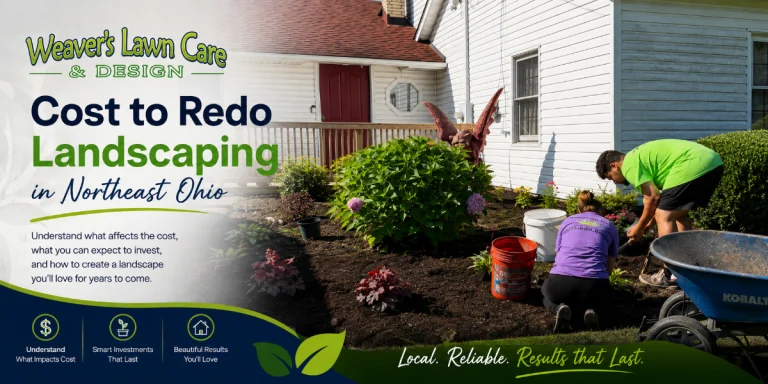
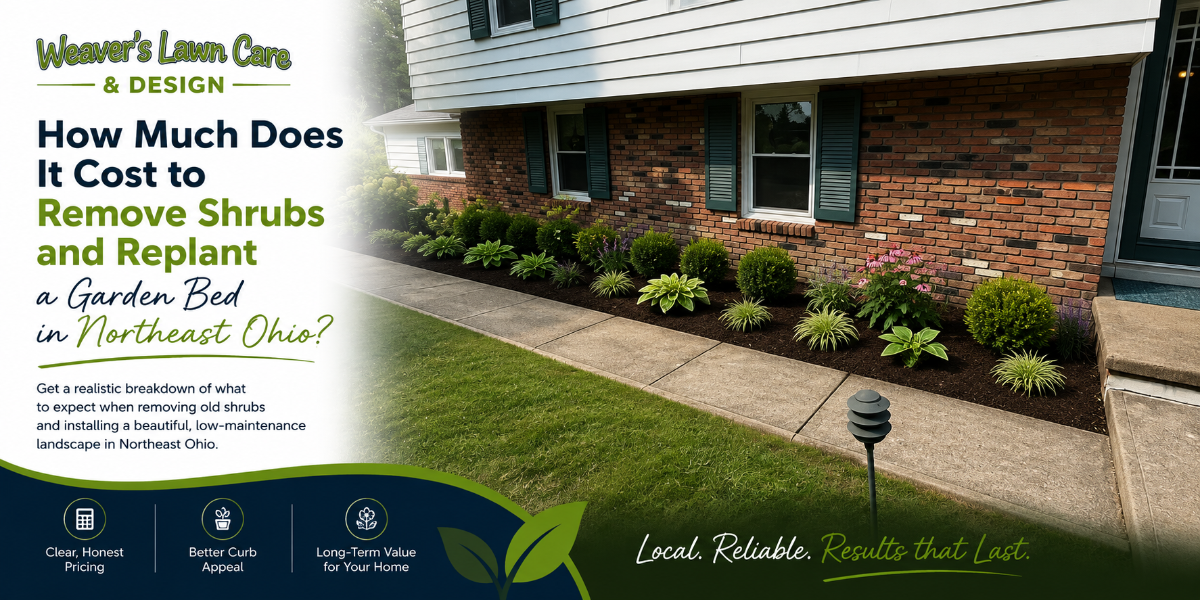
Shrub Removal & Replanting Cost in Northeast Ohio
Shrub removal can look like a fairly small landscaping project until you start digging. An old foundation bed may only contain six or eight shrubs, but those plants can have decades of root growth underneath them. Once they are removed, the bed may also need to be reshaped, cleaned out, prepared for planting, replanted, edged, and mulched before it looks finished again.
That is why the cost to remove shrubs and replant a garden bed in Northeast Ohio varies considerably from one property to another.
For the types of residential projects we typically handle at Weaver's Lawn Care & Design, homeowners are often investing several thousand dollars when shrub removal is part of a complete garden bed renovation rather than a simple cleanup. A smaller, focused bed may cost less, while renovating multiple foundation beds with extensive removal and substantial new plantings can move into the $5,000 to $10,000 range or higher.
The important distinction is what happens after the shrubs come out. Removing six old shrubs and putting six new shrubs into the same holes is a very different project from redesigning an outdated front landscape.
For homeowners in Perry, Madison, Mentor, Painesville, Concord, Kirtland, Chardon, Geneva, and surrounding Northeast Ohio communities, here are the biggest factors that determine what a shrub removal and replanting project will cost.
Start with how much of the existing landscape actually needs to come out
Not every old shrub needs to be removed. In fact, one of the first things we look at during a garden bed renovation is whether there are established plants worth incorporating into the new design.
A healthy ornamental tree, hydrangea, evergreen, or other well-positioned shrub may already provide structure that would take years to recreate with a new plant. On the other hand, keeping plants that are badly overgrown or poorly located can limit what you are able to do with the rest of the bed.
Before removal begins, it helps to separate the existing landscaping into a few groups:
-
- Healthy plants that still fit their locations
- Plants that can be improved through pruning
- Oversized shrubs that will always be too large for the space
- Declining or damaged plants that no longer make sense to keep
Selective removal can save money and give the finished landscape a more established appearance. It also keeps the project focused on solving actual problems instead of automatically clearing everything to bare soil.
The size and age of the shrubs have a big effect on removal costs
There is a major difference between removing a recently planted shrub and taking out a mature yew that has been growing against a house for 25 years.
Large shrubs can have substantial root systems, heavy woody growth, and branches intertwined with neighboring plants. Access can also be tight around foundations, porches, air-conditioning equipment, walkways, and other parts of the property.
Shrub removal becomes more involved when:
-
- The plants are large and well established
- Root systems have spread through the surrounding bed
- Shrubs are growing close to the foundation or utilities
- Equipment cannot easily reach the planting area
A professional yard cleanup can handle the physical removal and disposal of unwanted landscape material. For a larger renovation, this clearing work becomes the first stage of preparing the property for a completely new planting layout.
Old landscape rock, fabric, and edging can add more work than expected
Sometimes the shrubs are the easy part.
Older Northeast Ohio garden beds can contain several generations of landscaping underneath the surface. You may find old plastic edging buried beneath newer edging, deteriorating landscape fabric, river rock mixed into the soil, or years of mulch that have accumulated around the plants.
These materials often need to be dealt with before new landscaping is installed.
Bed cleanup may include:
-
- Removing old landscape fabric
- Removing or relocating decorative stone
- Taking out damaged or outdated edging
- Clearing roots and debris left behind after shrub removal
This is one reason it can be difficult to price a garden bed renovation accurately from photographs alone. What is underneath an established bed can have almost as much influence on the work as what is visible above ground.
Deciding whether to keep the same bed shape affects the project
Once the old shrubs are gone, homeowners have an opportunity to reconsider the garden bed itself.
Many older foundation beds are relatively narrow. They were designed around a row of shrubs planted close to the house, and as those shrubs matured, they gradually filled all of the available space.
Installing new plants in exactly the same narrow strip can recreate the same problem.
Changing the bed shape can provide:
-
- More room between shrubs and the foundation
- Space for layered shrubs and perennials
- Better proportions between the landscaping and the house
- Cleaner transitions between the lawn and planting areas
A professional landscape design can determine whether expanding or reshaping the bed is worth including in the project. It adds work compared with simply replacing plants in place, but it can produce a much better long-term result.
A smaller garden bed renovation may stay below $5,000
Not every shrub removal project needs to become a major landscape renovation. If you have one relatively small bed with straightforward access, limited removal, and a modest number of new plants, the project may stay below the $5,000 level.
A smaller renovation might involve:
-
- Removing several unwanted shrubs
- Cleaning and preparing the existing bed
- Installing a limited number of replacement shrubs and perennials
- Finishing the area with edging and mulch
The final cost depends heavily on the plants being removed and what is going back into the space. Replacing a few compact shrubs is very different from installing larger specimen plants or redesigning a long foundation bed.
For homeowners with a limited problem area, a focused landscape renovation can still make a noticeable improvement without extending the project across the entire front yard.
A $5,000 to $10,000 budget can handle a more substantial garden bed renovation
This is where homeowners can usually start thinking beyond simple plant replacement.
If several established shrubs need to be removed and the bed itself needs improvement, a budget in the $5,000 to $10,000 range can allow for more meaningful changes. Depending on the property, that might mean renovating a larger front foundation bed or addressing several connected planting areas.
A project in this range could include:
-
- Removal and disposal of substantial existing shrubs
- Reshaping or expanding garden beds
- A new planting design using shrubs, perennials, and grasses
- Bed preparation, edging, and fresh mulch
This is often the point where professional landscape planning becomes especially useful. Instead of asking what can replace each individual shrub, you can step back and decide how the entire planting area should look and function.
Larger front yard renovations can exceed $10,000
If shrubs need to be removed from several areas around the house, the project can move beyond a single garden bed renovation.
For example, a homeowner may want to replace the overgrown shrubs across the front foundation, update the landscaping beside the driveway, improve the entrance, and renovate a bed wrapping around the side of the house. At that point, plant quantities and labor begin to add up quickly.
A larger project may include:
-
- Extensive removal across multiple garden beds
- New shrubs, perennials, ornamental grasses, and small trees
- Changes to bed shapes throughout the front yard
- Additional improvements such as landscape lighting
Weaver's can approach this type of work as a complete residential landscape renovation rather than treating each garden bed as an unrelated project. That helps the planting design remain consistent across the property.
The plants you choose can change the price significantly
Once removal and preparation are complete, new plant material becomes another major part of the budget.
Plant pricing varies based on species, variety, size, availability, and the amount of material required. A design using mostly smaller perennials and compact shrubs will have a different plant budget from one using larger shrubs and ornamental trees for immediate impact.
When choosing replacement plants, consider:
-
- The mature height and width of each plant
- How quickly you want the landscape to fill in
- The amount of seasonal color you want
- How much future maintenance you are comfortable with
During a planting design, the goal is to balance the initial appearance with what the landscape will become over time. Larger plants can create a more immediate transformation, but smaller properly spaced plants may make more sense in other areas.
Replacing every old shrub with another shrub is not always the best approach
Older foundation landscaping often consists almost entirely of shrubs. Once those plants are removed, homeowners sometimes assume every empty spot needs another shrub.
It usually does not.
A renovated bed can use a combination of plant types to create more interest and reduce the heavy appearance of a continuous hedge.
A new planting might combine:
-
- Compact evergreens for winter structure
- Hydrangeas or other flowering shrubs
- Perennials for seasonal flowers
- Ornamental grasses for movement and texture
This type of layered landscape installation can also make better use of a renovation budget. Instead of purchasing a large shrub for every opening, different plants can be used according to the role they actually need to play.
Proper spacing can save you from paying for another renovation later
One of the easiest ways to waste money on a new garden bed is to overplant it.
After removing an established landscape, homeowners are used to seeing a very full bed. New plants can look small by comparison, which creates an understandable temptation to add more.
Those plants are going to grow.
Proper spacing should account for:
-
- Mature plant width
- Clearance from windows and the house
- Space around walkways and steps
- Room between neighboring shrubs and perennials
Professional landscape design and installation considers what the garden bed should look like several years from now. Spending money to make a new landscape look completely full on installation day can result in paying to remove overcrowded plants later.
Mulch and finished bed edges are part of the renovation
After thousands of dollars have been invested in removal and new plants, the bed should not be left looking unfinished.
Fresh mulch visually ties the new plants together, covers the open areas that have intentionally been left for future growth, and helps reduce weed pressure while retaining soil moisture.
Professional mulch installation is commonly the final step in a renovated garden bed.
A finished bed should have:
-
- Clean, defined edges
- Consistent mulch coverage
- Proper clearance around plant stems and trunks
- A shape that works with the surrounding lawn
These details may not be the most exciting part of a landscape renovation, but they have a significant effect on how complete the finished project looks.
Think about maintenance before choosing the replacement plants
If you are removing shrubs because you are tired of constantly trimming them, the new landscape should not put you back in exactly the same situation.
This is the time to tell your landscape designer how much work you actually want to do.
A lower-maintenance garden bed might use:
-
- Shrubs that naturally remain within the available space
- Fewer plant varieties repeated in larger groups
- Perennials and grasses that primarily need seasonal cleanup
- Simple bed shapes that are easy to mow around
Weaver's also provides landscape maintenance services for homeowners who prefer ongoing professional care. Even then, choosing appropriately sized plants can reduce unnecessary pruning and help the renovated beds keep their intended appearance longer.
DIY shrub removal can become a much bigger job than it looks
Removing one small shrub is a reasonable weekend project for many homeowners. Removing an entire mature foundation landscape is something different.
Large root systems can be difficult to dig out by hand, particularly in compacted soil. Working close to the foundation, utilities, irrigation, lighting, or other plants adds another layer of difficulty. Afterward, you still have a pile of shrubs and roots that needs to be hauled away.
A complete renovation can require:
-
- Equipment for established shrub and root removal
- Hauling and disposal of landscape debris
- Bed preparation after the old material is removed
- Correct layout and installation of the replacement plants
Working with a professional garden bed renovation contractor also means the removal is being done with the finished landscape in mind. That is usually more productive than spending several weekends tearing everything out and only then deciding what the empty space should become.
Landscape lighting can be worth adding while the beds are already being redone
Landscape lighting is not necessary for every garden bed renovation, but if you have been considering it, installing it alongside the new landscaping can make sense.
The plants and lighting can be planned together instead of trying to fit fixtures into an established bed later.
Professional landscape lighting can be used to:
-
- Highlight an ornamental tree or specimen plant
- Add visibility near the front entrance
- Illuminate portions of a walkway
- Add depth to the front landscape after dark
Lighting will increase the project budget, but for homeowners already making a significant investment in the front of the property, it can add another dimension to the finished renovation.
Choose a Northeast Ohio landscaper who looks beyond the shrubs
The cost of removing shrubs and replanting a garden bed should not be viewed as a simple price per shrub. The real project is the landscape that will be left behind after those shrubs are gone.
Weaver's Lawn Care & Design is a locally owned, husband-and-wife operated company providing residential landscaping and garden bed renovation throughout Lake County and surrounding Northeast Ohio communities. Bob Weaver manages operations, crews, and client relationships, while co-owner Jessica leads the landscape design side of the business.
When evaluating an older garden bed, we can look at which plants should stay, what needs to be removed, whether the bed itself should change, and which new plants make sense for the sunlight, available space, house, and homeowner's maintenance preferences.
That approach can also help establish where the budget will make the biggest difference. A $5,000 renovation may need to stay focused on one important area, while a larger budget can address several connected beds and create a more complete transformation.
Proudly serving homeowners throughout Lake County and Northeast Ohio
Weaver's Lawn Care & Design provides landscape design, shrub removal, garden bed renovation, planting, landscape lighting, mulch, lawn care, and property maintenance throughout our Northeast Ohio service area, including:
-
- Madison
- Perry
- Geneva
- Mentor
- Painesville
- Concord
- Chardon
- Kirtland
- Eastlake
- Wickliffe
- Willowick
Many homes in this part of Northeast Ohio have landscaping that has been growing for decades. Mature shrubs, changing shade, old landscape materials, and narrow foundation beds can all influence what is involved in renovating them.
Along with garden bed renovations, Weaver's can help with landscape design, new plantings, mulch, shrub trimming, landscape lighting, seasonal cleanup, lawn care, and ongoing maintenance when those services make sense for the property.
Get an estimate for removing and replacing your old shrubs
If you have an old row of shrubs that has taken over the front of your house, the project does not have to begin with removing everything. The first step should be figuring out which plants are causing problems and what you want the garden bed to become afterward.
For a smaller, straightforward bed, the investment may stay below $5,000. When a project involves substantial shrub removal, a redesigned bed, new shrubs and perennials, preparation, edging, and mulch, $5,000 to $10,000 or more can be a more realistic planning range. Larger front yard renovations involving several beds, extensive plant material, or additional improvements can go beyond that.
Those figures are useful for planning, but the actual cost depends on what is growing around your house, how difficult it is to remove, the size and condition of the beds, and what you want installed in its place.
The best way to establish a useful budget is to evaluate the existing landscape before removal begins.
Contact Weaver's Lawn Care & Design to request a garden bed evaluation and estimate for shrub removal, landscape renovation, and replanting in Perry, Madison, Mentor, Painesville, Concord, Kirtland, Chardon, Geneva, or the surrounding Northeast Ohio area.